The Prompt Is the New Programming Language: How Great Prompts Unlock Extraordinary AI Results
✦ Quick Answer
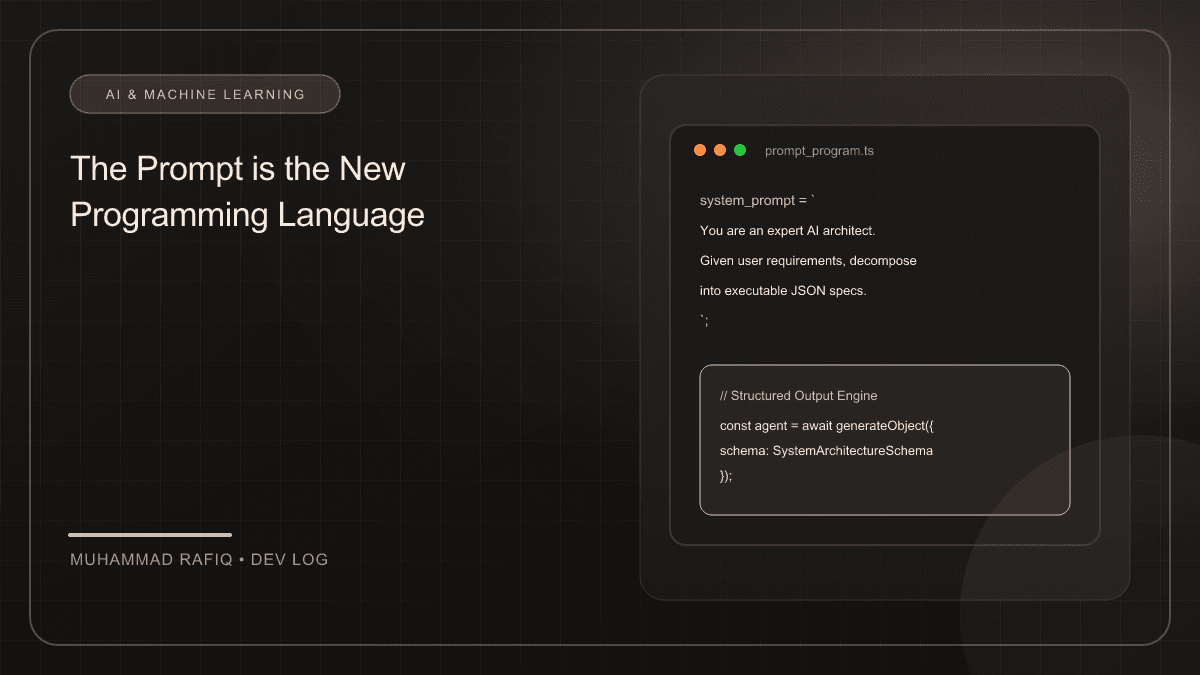
Prompt engineering is the new programming language of the generative AI era. It is the skill of translating human ideas into clear, structured instructions (including roles, objectives, context, constraints, output structure, and quality standards) that AI models like Claude or Gemini can interpret and execute. Elevating prompt quality directly determines output quality, reducing generic assumptions and eliminating ambiguity.
TL;DR Summary
What You'll Build
A framework guide to prompt architecture, defining role behaviors, enforcing constraints, and prompt development.
Technologies Used
Key Learning Outcomes
- Define detailed role personas and specific objective success criteria.
- Provide contextual environment variables and enforce strict constraints.
- Specify output formats and set step-by-step thinking quality standards.
- Iterate and refine prompts based on output evaluations.
Introduction
Artificial Intelligence has changed the way we build software, create content, design products, and solve complex problems. Yet many people still believe that AI produces average results because the models are limited. But the truth is different: the quality of an AI's output is often determined by one thing: the quality of the prompt.
A well-written prompt can transform an average response into something that feels like it was created by an experienced professional. Whether you're using ChatGPT, Claude, Gemini, Midjourney, or any modern AI model, your prompt is no longer just an instruction. It is the blueprint that shapes the final result.
Prompt Engineering Is Becoming a Core Skill
A few years ago, knowing how to write code gave developers a significant advantage. Today, knowing how to communicate effectively with AI is becoming just as valuable. Prompt engineering is the skill of translating ideas into clear, structured instructions that an AI can understand and execute. Think of AI as a highly capable assistant.
If you say:
"Create a website."
You'll receive something generic. But if you say:
"Create a responsive SaaS landing page using React, Tailwind CSS, and TypeScript. Follow Apple's minimalist design philosophy with smooth animations, accessible components, SEO optimization, dark mode support, reusable architecture, production-ready code, and clean folder organization."
The difference is dramatic. The AI hasn't become smarter—your prompt has become better.
Why Most AI Results Feel Generic
Many people expect AI to read their minds. They provide one sentence and hope for a masterpiece. However, the AI doesn't know:
- Your goal
- Your audience
- Your preferred style
- Your constraints
- Your quality expectations
When these details are missing, the AI fills the gaps with assumptions. Those assumptions usually produce average, generic results.
The Anatomy of a Great Prompt
A high-quality prompt answers the questions the AI would ask if it could interview you. We can break this down into six key pillars:
1. Define the Role
Tell the AI who it should become (e.g., Senior Software Engineer, Product Designer, Marketing Strategist, Security Auditor, Technical Writer, or Prompt Engineer).
"Act as a Senior Full Stack Engineer with expertise in React, Next.js, TypeScript, Supabase, and production-grade architecture."
2. Explain the Objective
Be specific about what success looks like. Instead of saying Build an admin dashboard, try:
"Build a production-ready admin dashboard for internship management with authentication, analytics, role-based access, responsive UI, audit logs, and scalable architecture."
3. Provide Context
AI performs significantly better when it understands the environment. Include information such as:
- Existing technology stack and project structure
- Business requirements and user personas
- Current technical limitations and codebase standards
Context removes guesswork and guides the model to produce context-aware solutions.
4. Define Constraints
Tell the AI what it must avoid to keep precision high:
- "Don't break the existing UI layouts."
- "Maintain backward compatibility with older API versions."
- "Follow TypeScript strict mode rules and avoid utilizing `any`."
- "Avoid introducing external runtime libraries unless absolutely necessary."
5. Specify the Desired Output
Don't leave the formatting to chance. Request specific output formats, such as: markdown docs, modular production-ready code, API schemas, architectural diagrams, or step-by-step checklists. The clearer the structure, the cleaner the response.
6. Set Quality Standards
This is where prompts become exceptional. Explicitly ask the model to: think step-by-step, review its own work before responding, optimize for runtime speed, check for common security bugs (OWASP), and suggest improvements. Now, the AI isn't just generating—it is auditing and self-correcting.
The Difference Between Good and Great Prompts
To see the power of these instructions in action, consider the same model answering two different prompts:
Weak Prompt
"Create a login page."
Result: A basic HTML/CSS form with no state validation, accessibility layers, or responsive safety guidelines.
Strong Prompt
"Act as a Senior Frontend Engineer. Create a production-ready authentication page using React, TypeScript, Tailwind CSS, and React Hook Form. Include responsive design, dark mode, accessibility, loading states, validation, error handling, password visibility toggle, reusable components, clean folder structure, and best security practices. Optimize for performance and maintainability."
Result: Fully structured, type-safe React code utilizing modern accessible forms, production input validators, styling themes, and modular interfaces.
The model did not change. The instruction quality did.
Prompt Engineering Is About Reducing Ambiguity
Large language models predict the most likely response based on matching patterns in their training data. Every vague phrase introduces noise and uncertainty. Every specific detail removes options until only the correct path remains. The ultimate goal of prompt engineering is to eliminate ambiguity until the model has only one logical, high-quality response vector to choose.
Think Like an Architect, Not Just a User
The best prompts are designed like software specification sheets. They answer questions before the developer needs to ask. If you hired a developer, you wouldn't say Build me an app and walk away. You would detail the features, requirements, timeline, technologies, constraints, and success criteria. Treat AI with the same architectural standard.
Iteration Creates Excellence
Even veteran prompt engineers rarely achieve the perfect generation on their first attempt. The engineering workflow is highly iterative:
- Write an initial prompt outline.
- Review the generated output.
- Identify missing contexts, bugs, or style misalignments.
- Refine prompt instructions and add constraints.
- Repeat until the generated asset is production-ready.
Each iteration reveals how the model maps specific tokens to patterns. Over time, this feedback loop trains your brain to write cleaner initial blueprints.
The Future Belongs to Those Who Can Ask Better Questions
While LLM models will improve in raw capability, clear communication remains a premium human skill. The individuals who learn how to structure complex ideas, define tight objectives, provide accurate context, and guide AI engines with precision will consistently outperform those relying on vague prompts.
Prompt engineering isn't merely about talking to machines. It's about learning to think clearly, communicate efficiently, and solve technical challenges with deliberate intention.
Conclusion
A great prompt is more than a command; it is a blueprint giving the model direction, bounds, and purpose. As generative AI embeds deeper into everyday operations, crafting high-precision prompts will emerge as one of the most valuable technical capabilities in our digital toolkit.
"Better prompts don't just generate better answers—they create better outcomes."
Frequently Asked Questions
Why do simple prompts produce average or generic AI responses?
Simple prompts lack detailed goals, contexts, and constraints. Without these bounds, the AI must fill the gaps with general assumptions, leading to standard or average results.
What is the anatomy of a great prompt?
A great prompt defines the role, explains the objective, provides context, sets constraints, specifies the desired output format, and dictates quality standards like step-by-step reasoning.
How do you enforce code safety or prevent UI layout breaks using prompts?
By setting strict constraints in the prompt context (e.g., instructing the model never to break layouts, specify type-safety rules, return strict format wrappers, and self-review before output).
What is the role of iteration in prompt engineering?
Iteration is the process of reviewing the model output, identifying gaps, and refining prompt specifications. It aligns human intent with AI interpretation over successive runs.