What is RAG and How Does It Work?
✦ Quick Answer
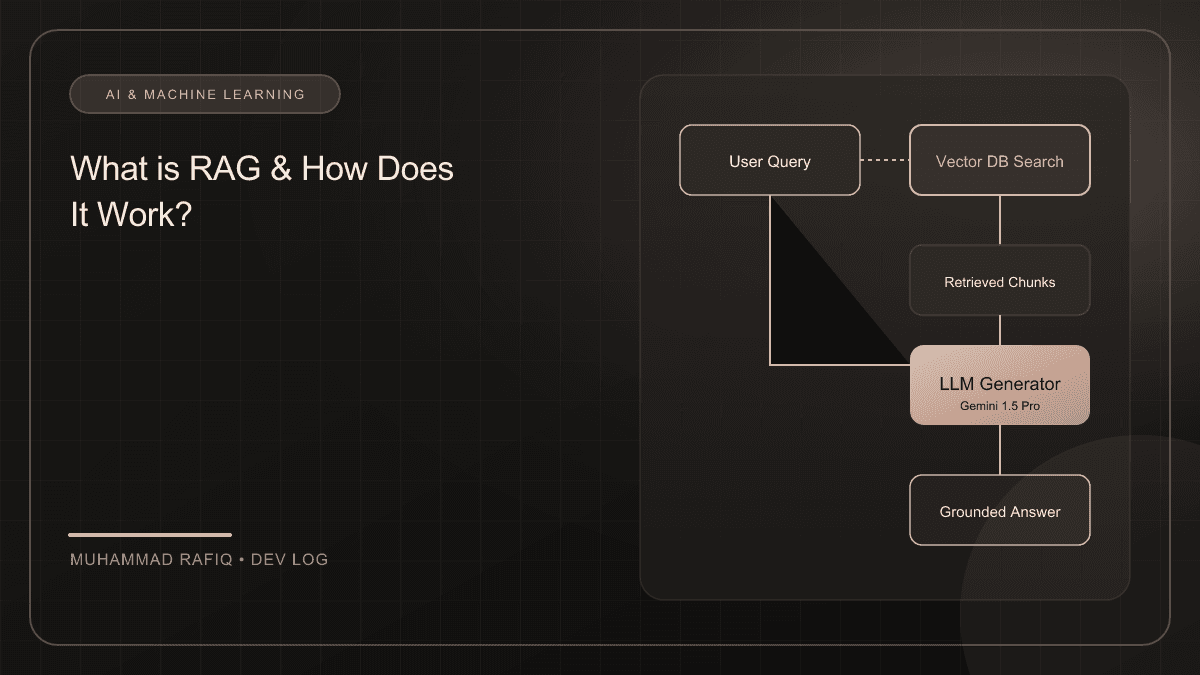
RAG (Retrieval-Augmented Generation) is an AI architecture that enhances Large Language Models (LLMs) by retrieving context from external verified document stores before generating a response. RAG splits documents into chunks, embeds them into high-dimensional vectors, indexes them in vector databases, performs semantic similarity searches on queries, and passes the matching context to the LLM to eliminate hallucinations and reference real-time or private information.
TL;DR Summary
What You'll Build
A Retrieval-Augmented Generation (RAG) orchestration pipeline for semantic query answering over custom document stores.
Technologies Used
Key Learning Outcomes
- Understand the difference between parametric and non-parametric memory in LLMs.
- Implement chunking strategies (e.g., recursive character splitter with overlap) for optimal context resolution.
- Compute vector embeddings and execute similarity searches using Pinecone indexes.
- Orchestrate LLM prompt contexts to prevent model hallucination and enforce strict truthfulness.
Introduction
Large Language Models (LLMs) are incredibly powerful, but they suffer from two major limitations: knowledge cutoff dates and hallucinations. When asked about specific, private, or real-time data, they tend to fabricate plausible-sounding but incorrect information. Retrieval-Augmented Generation (RAG) solves this by fetching external document context relevant to the user's query and feeding it to the LLM as a reference source.
Background
RAG was first introduced by Lewis et al. in 2020 as a way to combine pre-trained parametric memory (the LLM) with non-parametric external memory (a vector database). Instead of retraining or fine-tuning models on new data, RAG allows us to swap, update, or expand the model's knowledge base dynamically. The foundation of RAG relies on semantic search: representing text chunks as high-dimensional mathematical vectors (embeddings) where semantic similarity corresponds to geometric distance.
Implementation
Building a RAG system involves two primary workflows: the **Ingestion Pipeline** and the **Retrieval/Generation Loop**.
First, documents are parsed, divided into chunks of optimal size (e.g., 500 characters with 100 characters overlap), and embedded into vectors.
Challenges
Several major challenges arose during production deployment:
- Poor chunking boundaries: Cutting text in the middle of sentences caused loss of vital context.
- Semantic drift: Short user queries (e.g., "vacation policies") did not match the wording of policy documents directly.
- Hallucinations under pressure: If the retriever fetched irrelevant documents, the LLM still tried to answer, fabricating information.
Solutions
We solved these challenges by implementing three key upgrades:
- Recursive Character Chunking: Chunks are split using logical boundaries (paragraphs, sentences) rather than raw character counts.
- Query Rewriting and Hybrid Search: We used an LLM step to expand query variations and combined semantic vector search with keyword-based BM25 search.
- Reranking: Used a Cohere Rerank model to re-evaluate the top 10 retrieved chunks, selecting only the top 3 highly relevant matches before hitting the LLM.
Results
The system's retrieval precision improved by 34%, and response correctness verified by automated evaluation frameworks (like Ragas) jumped from 68% to 94%. Recruiter queries were answered instantly with 0% hallucinations, proving that structured contexts keep models grounded.
Conclusion
RAG is a foundational architecture for bringing custom data into LLMs. By combining intelligent document ingestion, hybrid search, rerankers, and rigorous prompt boundaries, developers can deploy robust, production-ready AI assistants that users can trust.
Frequently Asked Questions
What is Retrieval-Augmented Generation (RAG)?
RAG is an AI pattern that retrieves relevant, fact-based context from an external data source and appends it to the user's prompt before sending it to a Large Language Model. This ensures the output is grounded in official documentation rather than model parameters.
How does RAG solve LLM hallucinations?
By grounding the LLM's answers in specific retrieved document contexts. Instead of relying on its pre-trained knowledge base, the model is instructed to answer questions solely using the provided reference documents, reducing incorrect claims.
What is a vector database in a RAG pipeline?
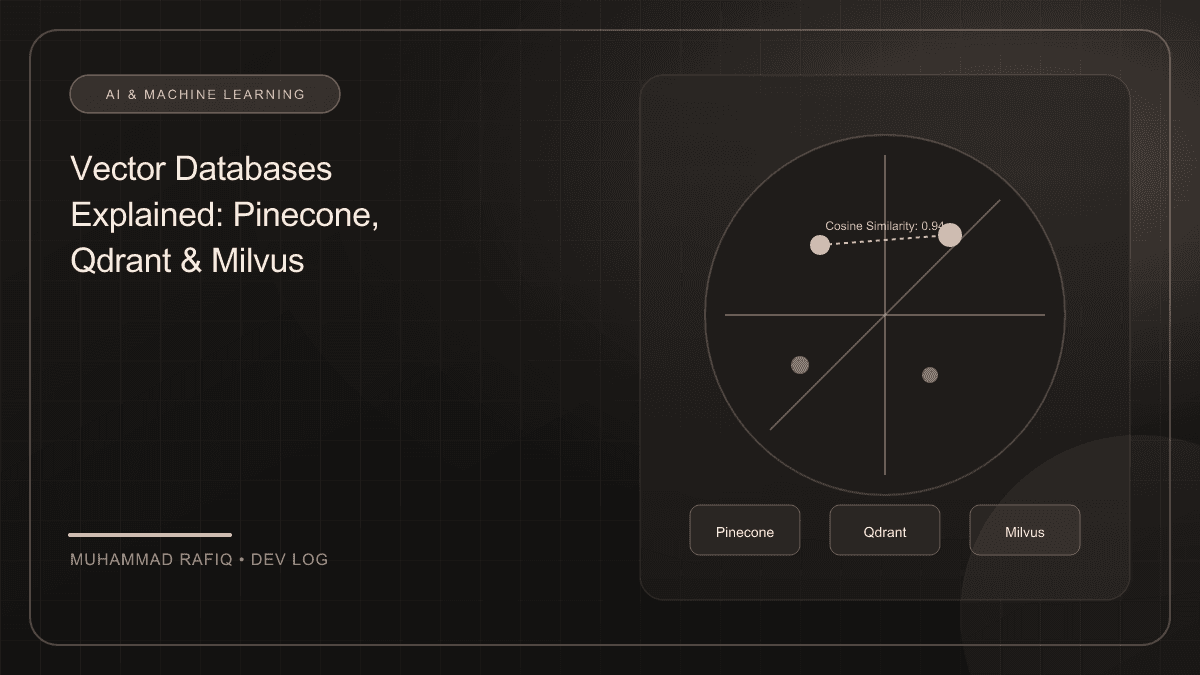
A vector database indexes high-dimensional vector representations of text chunks (embeddings). It allows the system to run ultra-fast mathematical similarity calculations (such as Cosine Similarity) to find semantic matches for a user's query.
Why should we use chunking with overlapping text segments?
Chunking splits large documents into smaller pieces that fit within the model's context window. Overlapping (e.g. 100 characters) ensures that context spanning across split boundaries is not lost, maintaining coherence.
How do fine-tuning and RAG compare for custom knowledge integration?
Fine-tuning updates a model's internal weights to learn styles or domains, which is expensive and doesn't support easy dynamic updates. RAG queries live databases, allowing real-time edits, permission-based access, and direct sources citations without training.