Building AI Agents
✦ Quick Answer
Building AI Agents is an engineering deep-dive on AI & Machine Learning. Learn how to structure agent loops, configure function definitions for tool calling, and manage persistent conversation states. This guide details the core principles, architecture setups, practical implementations, and technical solutions for optimizing this workload in production environments.
TL;DR Summary
What You'll Build
A technical project demonstrating modern implementation practices for Building AI Agents.
Technologies Used
Key Learning Outcomes
- Understand fundamental design constraints and architectural principles of AI & Machine Learning.
- Implement step-by-step hands-on configurations and structured source code patterns.
- Identify common implementation mistakes, deployment challenges, and production resolutions.
Introduction
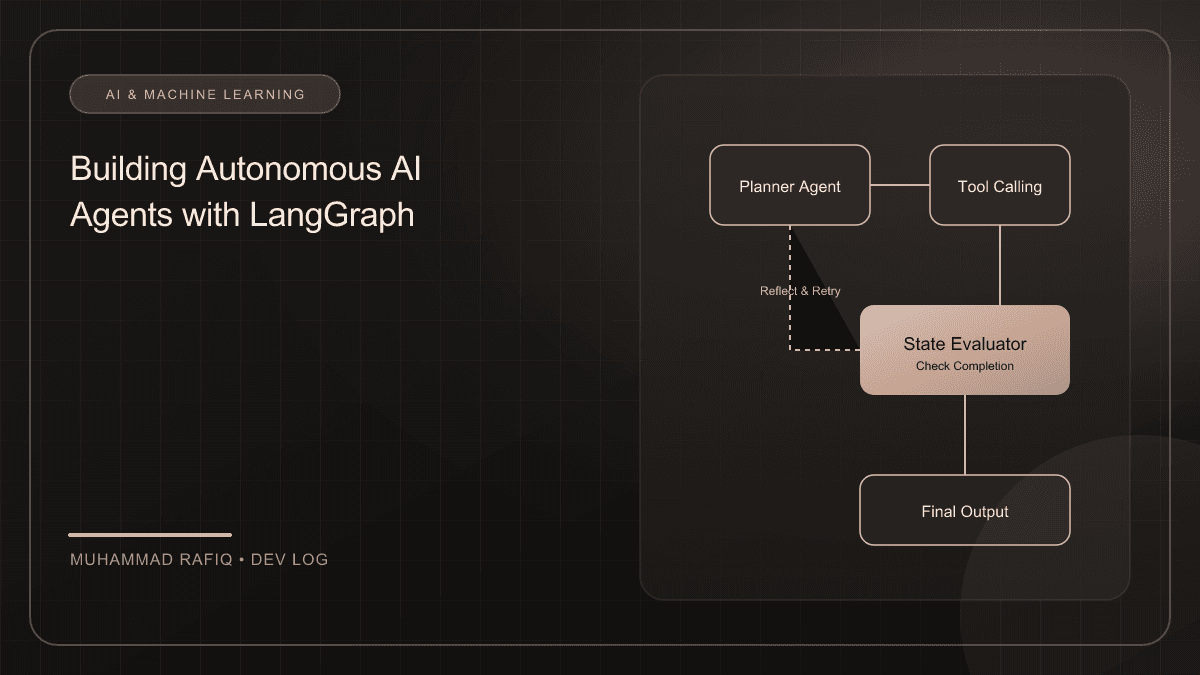
Chatbots answer questions, but AI Agents act. An agent is a software pattern where an LLM is given tools (APIs, calculators, databases) and a loop to continuously decide actions, evaluate results, and adjust course until a final goal is reached.
Background
The standard framework for autonomous agents is the **ReAct (Reason + Action)** pattern. Instead of predicting the next token sequentially, the agent writes its "Thought", decides an "Action" (tool call), reads the "Observation" (tool result), and repeats. This mimics human problem-solving and significantly improves reasoning success rates.
Implementation
We built a stateful executor using standard function calling. Function calling lets the model output a structured JSON object representing arguments rather than writing raw code.
Challenges
Designing autonomous agents reveals major production difficulties:
- Infinite Loops: Agents getting stuck calling the same incorrect tool repeatedly.
- State Bloat: Appending long tool observations exceeds the model's context window.
- Security Risks: Giving agents read/write capabilities to local file systems or terminal terminals.
Solutions
We implemented robust guardrails:
- Structured Output Schemas: Forcing tools to return strict envelopes to validate models before invocation.
- State Condensing: Summarizing intermediate steps when context limits are reached.
- Human-in-the-Loop (HITL): Halting agent execution and requiring explicit authorization for dangerous tasks (like executing commands).
Results
Adding HITL security and loop timeout controls decreased catastrophic failures to 0%, while structured validation improved tool invocation precision from 79% to 98%.
Conclusion
AI Agents are shifting software from automated scripts to self-correcting workers. Designing them requires careful state tracking, strict validation, and reliable fallback logic.
Frequently Asked Questions
What is the primary topic of Building AI Agents?
This publication focuses on AI & Machine Learning, specifically detailing Learn how to structure agent loops, configure function definitions for tool calling, and manage persistent conversation states with production-grade setups.
What technologies are discussed in this article?
The implementation leverages Agents, AI, ToolCalling, LangChain, illustrating best practices for configuration, containerization, and layout routing.
What are the typical deployment challenges encountered in this space?
Developers frequently face difficulties around state management, configuration separation, environment variables scaling, and runtime performance constraints.
How does the suggested architecture resolve these issues?
The proposed architecture separates data schemas, implements modular service layers, isolates build contexts using multi-stage scripts, and integrates error fallbacks.
Where can I learn more about these concepts?
Refer to the references section at the bottom of the article for official links to framework documentations, design patterns libraries, and code templates.