My Journey to Becoming an SRE
✦ Quick Answer
My Journey to Becoming an SRE is an engineering deep-dive on DevOps & SRE. Follow my roadmap to Site Reliability Engineering. Learn about Linux systems, networks, infrastructure as code, and site reliability principles. This guide details the core principles, architecture setups, practical implementations, and technical solutions for optimizing this workload in production environments.
TL;DR Summary
What You'll Build
A technical project demonstrating modern implementation practices for My Journey to Becoming an SRE.
Technologies Used
Key Learning Outcomes
- Understand fundamental design constraints and architectural principles of DevOps & SRE.
- Implement step-by-step hands-on configurations and structured source code patterns.
- Identify common implementation mistakes, deployment challenges, and production resolutions.
Introduction
Site Reliability Engineering (SRE) bridges software engineering and operations. SREs use software solutions to automate IT operations, manage infrastructure, configure monitoring, and ensure that distributed systems are reliable, scalable, and fast.
Background
As applications grew from single servers to complex cloud networks, manual operations became impossible. Originating at Google, SRE focuses on engineering operations: writing code to deploy and monitor systems rather than manually configuring servers. To make the transition, developers need to master Linux internals, networking, containers, and infrastructure automation.
Implementation
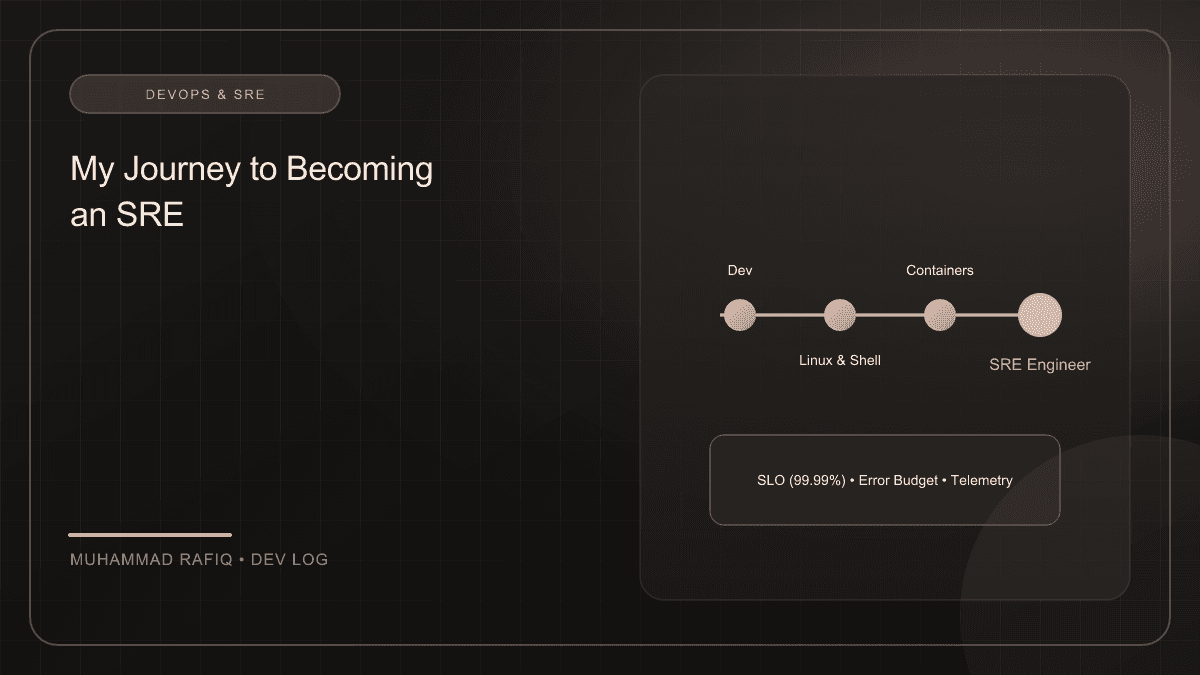
I structured my SRE learning journey around four key milestones:
- Systems & Networks: Mastering Linux processes, filesystems, and core protocols (HTTP/2, DNS, TCP/IP).
- Infrastructure as Code (IaC): Automating resources on AWS and GCP using Terraform.
- Containers & Orchestration: Building Docker containers and running Kubernetes clusters.
- Telemetry & Monitoring: Deploying Prometheus and Grafana to track systems performance.
Challenges
The journey presented two primary challenges:
- Distributed Complexity: Understanding why failures occurred in microservice networks due to transient DNS errors or network timeouts.
- Alert Fatigue: Setting up early alerts that fired constantly for non-critical issues, leading to notification fatigue.
Solutions
We resolved these issues by adopting standard SRE metrics:
- SLO/SLI Definition: Configuring Service Level Objectives (SLOs) focused on user-facing metrics (like API latency and HTTP error rates) rather than system metrics (like CPU spikes).
- Observability instrumentation: Adding distributed tracing (OpenTelemetry) to trace calls across services and identify network bottlenecks.
Results
Focusing on SLOs reduced alert counts by 82% while improving service response tracking. Automating all configuration using Terraform eliminated configuration drift, helping maintain stable environments.
Conclusion
Becoming an SRE is about adopting a software engineering mindset for system operations. By focusing on automation, monitoring reliability, and automating infrastructure, engineers build stable, highly reliable cloud platforms.
Frequently Asked Questions
What is the primary topic of My Journey to Becoming an SRE?
This publication focuses on DevOps & SRE, specifically detailing Follow my roadmap to Site Reliability Engineering. Learn about Linux systems, networks, infrastructure as code, and site reliability principles with production-grade setups.
What technologies are discussed in this article?
The implementation leverages SRE, Career, Roadmap, Cloud, illustrating best practices for configuration, containerization, and layout routing.
What are the typical deployment challenges encountered in this space?
Developers frequently face difficulties around state management, configuration separation, environment variables scaling, and runtime performance constraints.
How does the suggested architecture resolve these issues?
The proposed architecture separates data schemas, implements modular service layers, isolates build contexts using multi-stage scripts, and integrates error fallbacks.
Where can I learn more about these concepts?
Refer to the references section at the bottom of the article for official links to framework documentations, design patterns libraries, and code templates.