Kubernetes Fundamentals
✦ Quick Answer
Kubernetes Fundamentals is an engineering deep-dive on DevOps & SRE. Understand Kubernetes architecture. Learn how to configure Pods, expose Deployments, handle secrets, and autoscale containers. This guide details the core principles, architecture setups, practical implementations, and technical solutions for optimizing this workload in production environments.
TL;DR Summary
What You'll Build
A technical project demonstrating modern implementation practices for Kubernetes Fundamentals.
Technologies Used
Key Learning Outcomes
- Understand fundamental design constraints and architectural principles of DevOps & SRE.
- Implement step-by-step hands-on configurations and structured source code patterns.
- Identify common implementation mistakes, deployment challenges, and production resolutions.
Introduction
When running applications across dozens of servers, managing containers manually is impossible. Kubernetes (K8s) is an open-source container orchestration engine that automates deploying, scaling, and managing containerized applications at scale.
Background
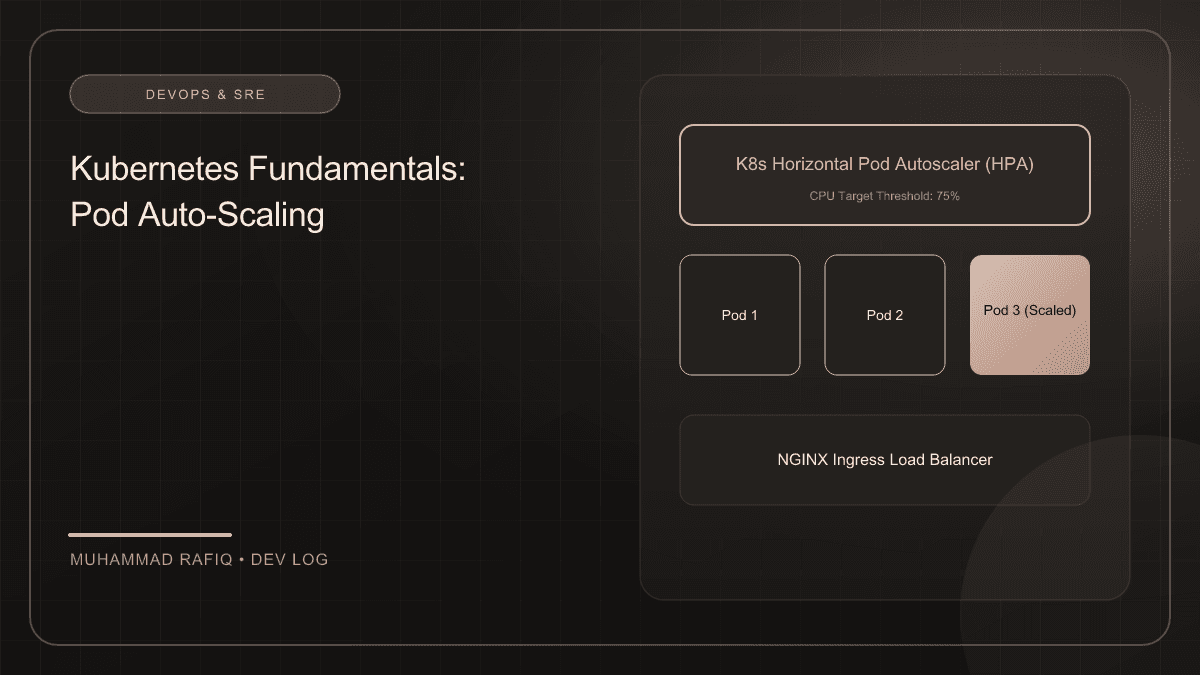
Unlike Docker Compose, which runs on a single host, Kubernetes manages clusters of virtual or physical machines. The core abstractions are:
- Pods: The smallest deployable units containing one or more containers.
- Deployments: Declarative templates that define the desired state for Pod replicas.
- Services: Network access definitions that expose Pods using stable DNS addresses.
Implementation
We configured a scalable Kubernetes Deployment that runs 3 replicas of our API and exposes them using a load balancer.
Challenges
Running Kubernetes in production reveals typical orchestration challenges:
- Resource Contention: Unchecked containers devouring CPU or memory, causing neighboring Pods to crash (OOM killed).
- Zero-downtime Rollouts: Deploying new images without dropping active connections.
Solutions
We solved this by establishing cluster configurations:
- Resource Limits: Setting explicit requests and limits (
resources: limits: memory: 512Mi, cpu: 500m) for every container. - Liveness and Readiness Probes: Configuring health endpoints to ensure Kubernetes only routes traffic to fully initialized Pods during rollouts.
Results
Configuring resource limits stabilized node RAM usage and eliminated all neighboring container OOM crashes, while readiness probes allowed zero-downtime rollouts of API updates.
Conclusion
Kubernetes is highly resilient but requires explicit resource declarations. By setting requests/limits and configuring liveness/readiness health checks, you build self-healing deployments that run reliably.
Frequently Asked Questions
What is the primary topic of Kubernetes Fundamentals?
This publication focuses on DevOps & SRE, specifically detailing Understand Kubernetes architecture. Learn how to configure Pods, expose Deployments, handle secrets, and autoscale containers with production-grade setups.
What technologies are discussed in this article?
The implementation leverages Kubernetes, K8s, DevOps, Scaling, illustrating best practices for configuration, containerization, and layout routing.
What are the typical deployment challenges encountered in this space?
Developers frequently face difficulties around state management, configuration separation, environment variables scaling, and runtime performance constraints.
How does the suggested architecture resolve these issues?
The proposed architecture separates data schemas, implements modular service layers, isolates build contexts using multi-stage scripts, and integrates error fallbacks.
Where can I learn more about these concepts?
Refer to the references section at the bottom of the article for official links to framework documentations, design patterns libraries, and code templates.