CI/CD with GitHub Actions
✦ Quick Answer
CI/CD with GitHub Actions is an engineering deep-dive on DevOps & SRE. Automate code verification. Master GitHub Actions configuration, caching strategies, and secure deployments to cloud platforms. This guide details the core principles, architecture setups, practical implementations, and technical solutions for optimizing this workload in production environments.
TL;DR Summary
What You'll Build
A technical project demonstrating modern implementation practices for CI/CD with GitHub Actions.
Technologies Used
Key Learning Outcomes
- Understand fundamental design constraints and architectural principles of DevOps & SRE.
- Implement step-by-step hands-on configurations and structured source code patterns.
- Identify common implementation mistakes, deployment challenges, and production resolutions.
Introduction
Manual testing and deployments are slow and prone to errors. Continuous Integration and Continuous Deployment (CI/CD) automates running tests on every pull request and deploying code immediately upon approval, ensuring that main branches remain production-ready.
Background
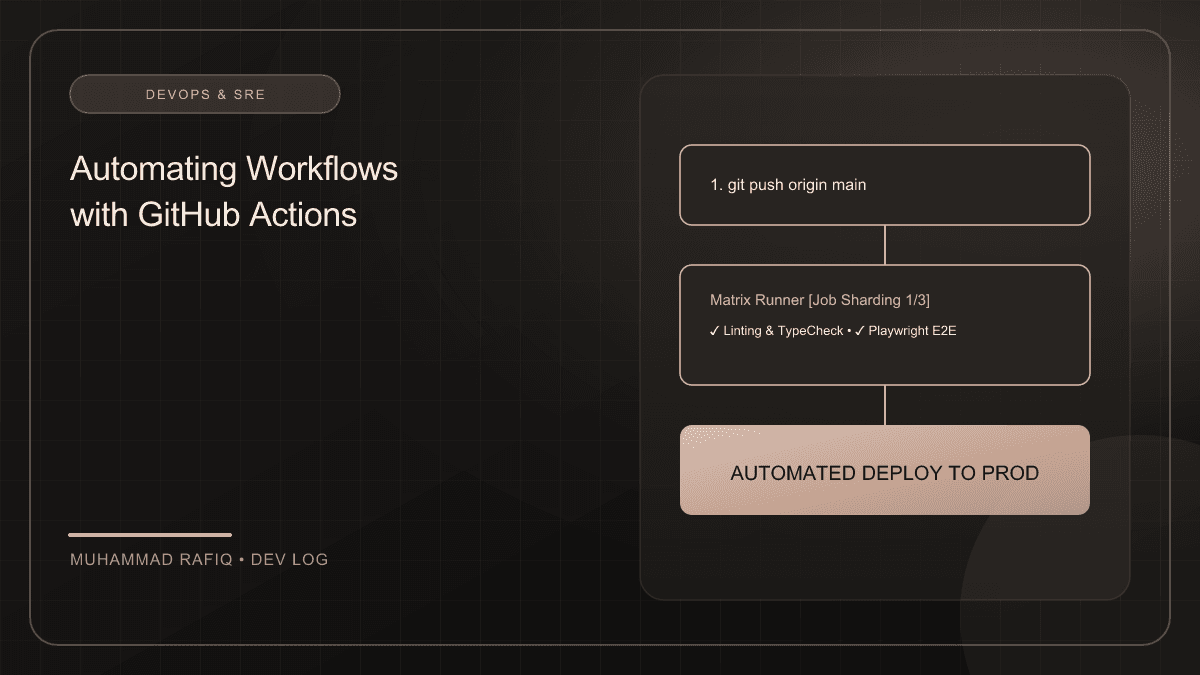
GitHub Actions has become an industry standard because it integrates directly into Git repositories. Developers write workflow configurations in YAML files under the .github/workflows/ directory, defining triggers (like push or pull_request) and jobs containing steps executed on virtual runners.
Implementation
We configured a CI pipeline that caches dependencies, runs code linters, and executes unit tests.
Challenges
Optimizing automated workflows introduces distinct challenges:
- Slow Pipeline Runs: Inefficient workflows taking over 10 minutes to run due to downloading dependencies on every step.
- Secret Leakage: Accidental exposure of cloud API keys or passwords inside runner logs.
Solutions
We optimized our pipelines with key upgrades:
- Dependency Caching: Leveraging
actions/setup-nodecaching parameters to reuse downloaded packages. - GitHub Secrets: Storing all keys in Repository Secrets and injecting them as environment variables only on deployment tasks.
Results
Re-using caches reduced average pull request build times from 9 minutes to 1.8 minutes. Restricting direct credentials access and scanning logs for secrets secured our deployment paths.
Conclusion
CI/CD is a core requirement for modern development teams. By automating test runs, caching dependencies, and securing credential access, you build robust pipelines that increase team shipping confidence.
Frequently Asked Questions
What is the primary topic of CI/CD with GitHub Actions?
This publication focuses on DevOps & SRE, specifically detailing Automate code verification. Master GitHub Actions configuration, caching strategies, and secure deployments to cloud platforms with production-grade setups.
What technologies are discussed in this article?
The implementation leverages CI-CD, GitHub, DevOps, Automation, illustrating best practices for configuration, containerization, and layout routing.
What are the typical deployment challenges encountered in this space?
Developers frequently face difficulties around state management, configuration separation, environment variables scaling, and runtime performance constraints.
How does the suggested architecture resolve these issues?
The proposed architecture separates data schemas, implements modular service layers, isolates build contexts using multi-stage scripts, and integrates error fallbacks.
Where can I learn more about these concepts?
Refer to the references section at the bottom of the article for official links to framework documentations, design patterns libraries, and code templates.