Docker for Developers
✦ Quick Answer
Docker for Developers is an engineering deep-dive on DevOps & SRE. Learn the fundamentals of Docker. Master writing lean multi-stage Dockerfiles, managing container volumes, and container networks. This guide details the core principles, architecture setups, practical implementations, and technical solutions for optimizing this workload in production environments.
TL;DR Summary
What You'll Build
A technical project demonstrating modern implementation practices for Docker for Developers.
Technologies Used
Key Learning Outcomes
- Understand fundamental design constraints and architectural principles of DevOps & SRE.
- Implement step-by-step hands-on configurations and structured source code patterns.
- Identify common implementation mistakes, deployment challenges, and production resolutions.
Introduction
"It works on my machine" is one of the most frustrating phrases in software development. Docker addresses this by packaging applications and their dependencies into immutable containers that run identically in development, staging, and production.
Background
Docker uses Linux kernel namespaces and cgroups to isolate processes. Unlike heavy Virtual Machines that run their own operating systems, Docker containers share the host kernel. This makes them lightweight, fast to boot, and highly resource-efficient.
Implementation
To run multi-container applications locally, we use Docker Compose. Compose simplifies running databases, caches, and application servers together with a single command.
Challenges
During initial setups, developers make common container mistakes:
- Bloated Image Sizes: Including development dependencies and source folders in production builds, yielding gigabyte-scale image sizes.
- Loss of local updates: Rebuilding container images on every code edit during local development.
Solutions
We solved this by establishing two patterns:
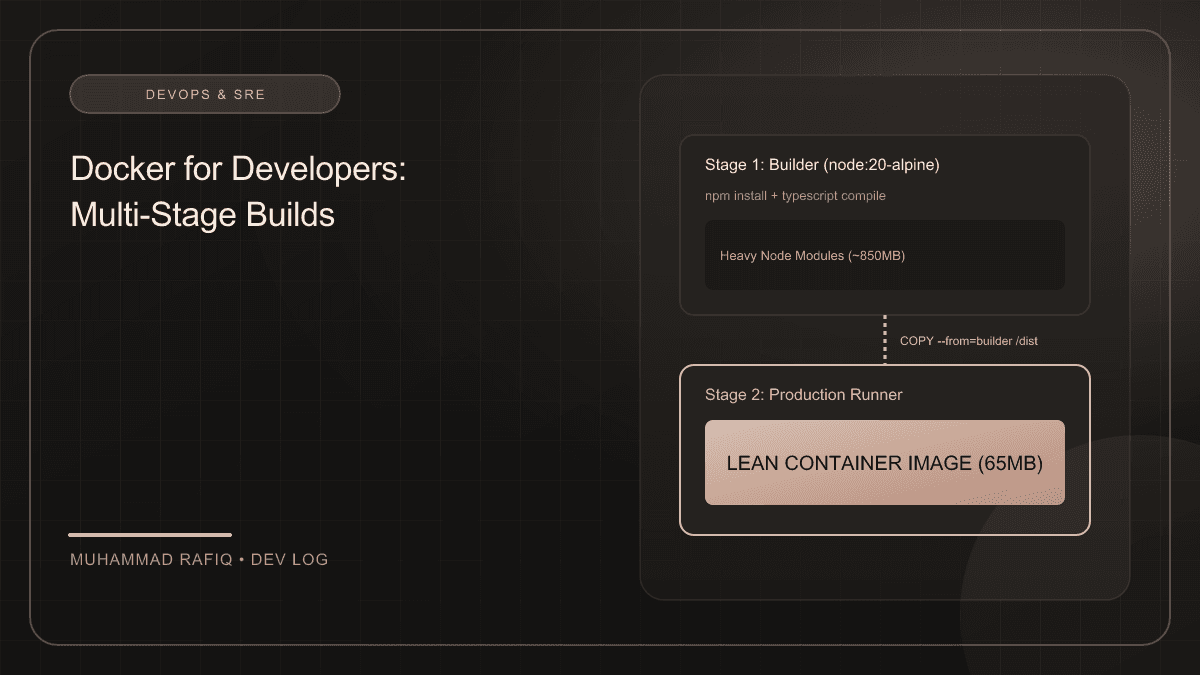
- Multi-stage Builds: Compiling source files in intermediate builder images and copying only built artifacts into clean runner environments.
- Bind Mounts and Watchers: Mounting local directories (
volumes: - .:/app) and running hot-reloading tools (likenodemonoruvicorn --reload) inside the container.
Results
Implementing multi-stage builds reduced our Node.js container image size from 1.2GB to 140MB. Adding bind mounts allowed developers to see local code updates instantly, keeping local development workflows fast.
Conclusion
Docker is a foundational skill for modern software development. By writing multi-stage Dockerfiles, managing volumes safely, and using Docker Compose, developers build fast, reproducible developer environments.
Frequently Asked Questions
What is the primary topic of Docker for Developers?
This publication focuses on DevOps & SRE, specifically detailing Learn the fundamentals of Docker. Master writing lean multi-stage Dockerfiles, managing container volumes, and container networks with production-grade setups.
What technologies are discussed in this article?
The implementation leverages Docker, Containers, DevOps, LocalDev, illustrating best practices for configuration, containerization, and layout routing.
What are the typical deployment challenges encountered in this space?
Developers frequently face difficulties around state management, configuration separation, environment variables scaling, and runtime performance constraints.
How does the suggested architecture resolve these issues?
The proposed architecture separates data schemas, implements modular service layers, isolates build contexts using multi-stage scripts, and integrates error fallbacks.
Where can I learn more about these concepts?
Refer to the references section at the bottom of the article for official links to framework documentations, design patterns libraries, and code templates.