Caching Strategies
✦ Quick Answer
Caching Strategies is an engineering deep-dive on System Design. Learn how to build caching layers. Master CDN edge caching, Redis eviction policies, and cache invalidation patterns. This guide details the core principles, architecture setups, practical implementations, and technical solutions for optimizing this workload in production environments.
TL;DR Summary
What You'll Build
A technical project demonstrating modern implementation practices for Caching Strategies.
Technologies Used
Key Learning Outcomes
- Understand fundamental design constraints and architectural principles of System Design.
- Implement step-by-step hands-on configurations and structured source code patterns.
- Identify common implementation mistakes, deployment challenges, and production resolutions.
Introduction
The fastest database query is the one you never make. Caching stores copies of computed data in fast, in-memory systems so future requests are answered instantly. However, caching introduces a major challenge: keeping cached data in sync with the source database.
Background
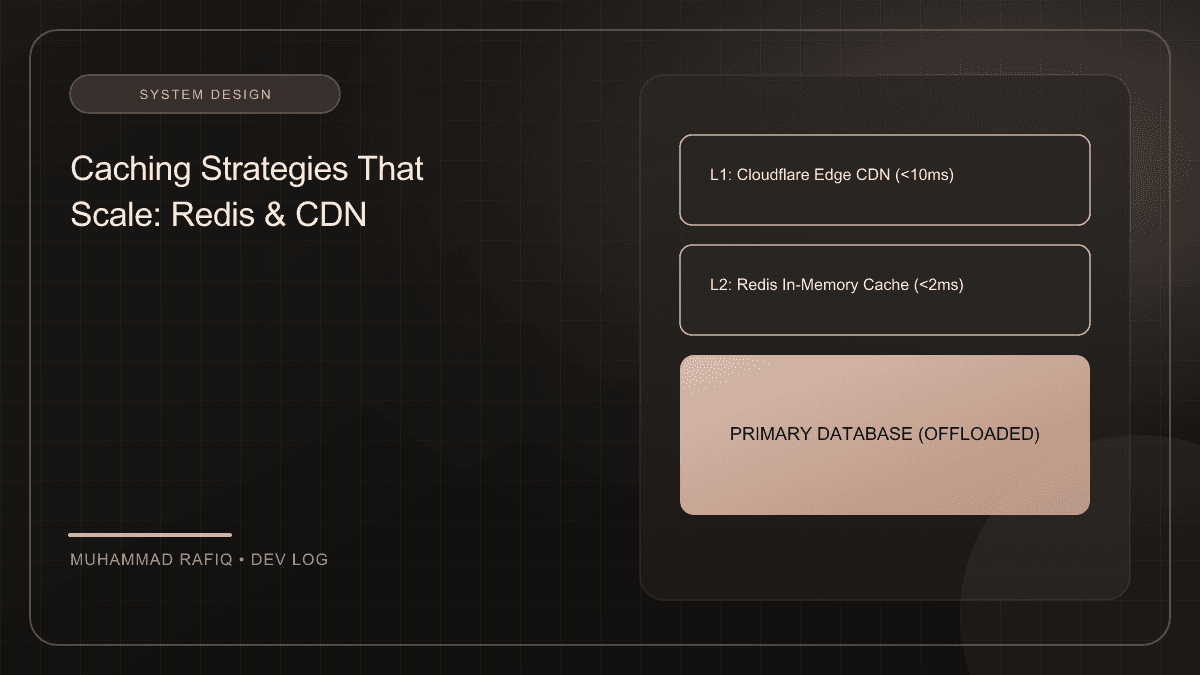
Caching can be applied at three primary levels: 1. **Edge (CDN)**: Caches static files and API responses geographically close to users. 2. **Application (Redis/Memcached)**: Stores database queries, user sessions, and heavy computations in-memory. 3. **Browser**: Uses HTTP headers to tell client browsers to store assets locally.
Implementation
We implemented a Cache-Aside pattern (Lazy Loading) inside our Node.js services. The application checks the Redis cache first. On a cache miss, it reads from the database, saves the result back to Redis with a Time-To-Live (TTL), and returns the response.
Challenges
Managing large caching layers presents several operational difficulties:
- Cache Invalidation: If data changes in the database, the cache remains stale until the TTL expires, leading to inconsistent user states.
- Cache Stampede: Under heavy concurrent load, multiple threads notice a cache miss simultaneously and hit the database at once, causing server crashes.
Solutions
We solved this by establishing robust caching policies:
- Write-Through invalidation: Database update events trigger cache evictions (
redis.del(cacheKey)) instantly. - Mutex Locking: Using lightweight Redis-based locks (Redlock) to ensure only a single worker fetches data from the database on a cache miss, while other requests wait.
Results
Integrating Redis reduced database read traffic by 85% during traffic spikes, and p99 response times dropped from 220ms to under 8ms.
Conclusion
Caching is essential for building fast, scalable applications. By combining CDN edge caches, lazy-loading Redis models, and transactional cache evictions, you can build systems that handle millions of requests without overloading databases.
Frequently Asked Questions
What is the primary topic of Caching Strategies?
This publication focuses on System Design, specifically detailing Learn how to build caching layers. Master CDN edge caching, Redis eviction policies, and cache invalidation patterns with production-grade setups.
What technologies are discussed in this article?
The implementation leverages Caching, Redis, CDN, Performance, illustrating best practices for configuration, containerization, and layout routing.
What are the typical deployment challenges encountered in this space?
Developers frequently face difficulties around state management, configuration separation, environment variables scaling, and runtime performance constraints.
How does the suggested architecture resolve these issues?
The proposed architecture separates data schemas, implements modular service layers, isolates build contexts using multi-stage scripts, and integrates error fallbacks.
Where can I learn more about these concepts?
Refer to the references section at the bottom of the article for official links to framework documentations, design patterns libraries, and code templates.