Monolith vs Microservices
✦ Quick Answer
Monolith vs Microservices is an engineering deep-dive on System Design. Analyze monolithic vs microservices architectures. Learn about operational overhead, communication patterns, and code deployment speed. This guide details the core principles, architecture setups, practical implementations, and technical solutions for optimizing this workload in production environments.
TL;DR Summary
What You'll Build
A technical project demonstrating modern implementation practices for Monolith vs Microservices.
Technologies Used
Key Learning Outcomes
- Understand fundamental design constraints and architectural principles of System Design.
- Implement step-by-step hands-on configurations and structured source code patterns.
- Identify common implementation mistakes, deployment challenges, and production resolutions.
Introduction
The Monolith vs Microservices debate is one of the most persistent topics in software engineering. Choosing the wrong architecture for your team size and product lifecycle can lead to slowed development, high hosting costs, or difficult-to-maintain codebases.
Background
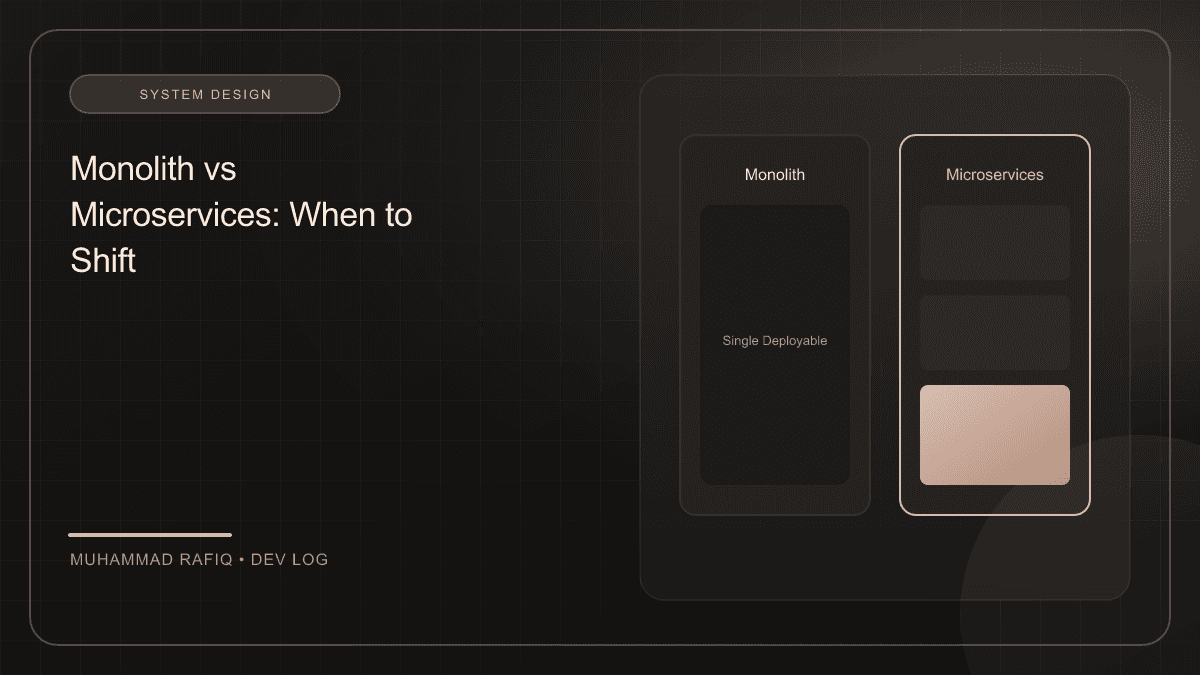
A Monolith bundles all logic, databases, and deployment routines into a single code repository. A Microservice architecture splits the product into small, independent services that run on separate servers and communicate over the network (e.g., via gRPC or HTTP APIs).
Implementation
Evaluating architectures requires assessing operational maturity, domain boundaries, and delivery speeds. Below is a comparison table outlining key tradeoffs:
| Attribute | Monolithic Architecture | Microservices |
|---|---|---|
| Operational Overhead | Low (simple deployments) | High (Kubernetes, service meshes, centralized logs) |
| Data Consistency | High (ACID transactions) | Eventual consistency (Sagas, Outbox pattern) |
| Codebase Complexity | High internal coupling | Clear network boundaries |
| Deployment Speed | Slower as app scales | Fast, isolated deployments per service |
Challenges
During architectural migrations, developers encounter common pitfalls:
- Distributed Monolith: Splitting services but keeping them tightly coupled via synchronous HTTP calls, inheriting the downsides of both systems.
- Data Isolation issues: Shared database instances accessed by multiple microservices, breaking service boundaries.
Solutions
We solved this by establishing clear rules: services must never share databases, and all cross-service notifications must be routed asynchronously using an event broker like RabbitMQ. We also set up a monolithic structure with strong internal boundaries (Modular Monolith) before attempting a full physical split.
Results
Moving from a single database to isolated microservice databases eliminated shared write locks and reduced code deployment blockages by 80%, while maintaining a modular structure helped the team scale from 3 to 18 developers without friction.
Conclusion
Start with a well-structured Modular Monolith. Shift to Microservices only when team scale demands physical boundaries, or when specific features have unique scaling requirements (e.g. machine learning pipelines vs simple CRUD pages).
Frequently Asked Questions
What is the primary topic of Monolith vs Microservices?
This publication focuses on System Design, specifically detailing Analyze monolithic vs microservices architectures. Learn about operational overhead, communication patterns, and code deployment speed with production-grade setups.
What technologies are discussed in this article?
The implementation leverages Architecture, SystemDesign, Microservices, Monolith, illustrating best practices for configuration, containerization, and layout routing.
What are the typical deployment challenges encountered in this space?
Developers frequently face difficulties around state management, configuration separation, environment variables scaling, and runtime performance constraints.
How does the suggested architecture resolve these issues?
The proposed architecture separates data schemas, implements modular service layers, isolates build contexts using multi-stage scripts, and integrates error fallbacks.
Where can I learn more about these concepts?
Refer to the references section at the bottom of the article for official links to framework documentations, design patterns libraries, and code templates.