Event-Driven Architecture
✦ Quick Answer
Event-Driven Architecture is an engineering deep-dive on System Design. Learn how to build asynchronous systems. Master Pub/Sub patterns, message reliability, dead letter queues, and transactional outboxes. This guide details the core principles, architecture setups, practical implementations, and technical solutions for optimizing this workload in production environments.
TL;DR Summary
What You'll Build
A technical project demonstrating modern implementation practices for Event-Driven Architecture.
Technologies Used
Key Learning Outcomes
- Understand fundamental design constraints and architectural principles of System Design.
- Implement step-by-step hands-on configurations and structured source code patterns.
- Identify common implementation mistakes, deployment challenges, and production resolutions.
Introduction
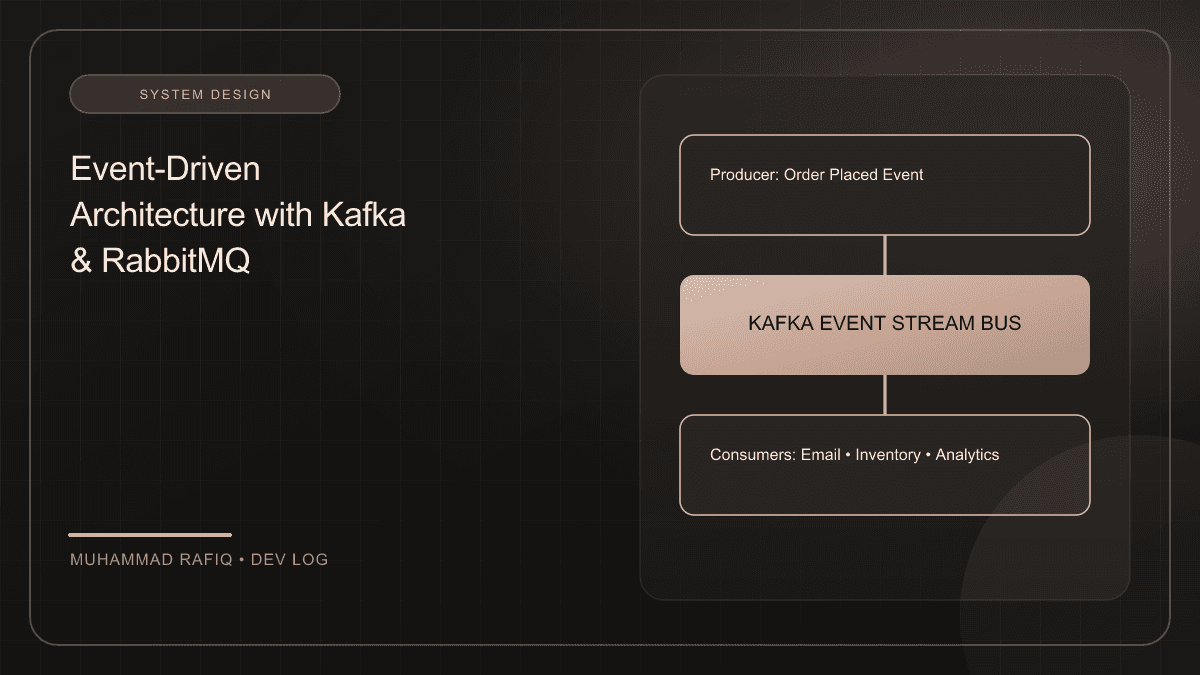
In synchronous API systems, Service A calls Service B and blocks while waiting for a response. If Service B is slow or down, Service A fails too. Event-Driven Architecture (EDA) decoupling replaces direct API calls with event notifications, allowing services to react to changes asynchronously.
Background
In an event-driven system, a service broadcasts an event (e.g., "OrderPlaced") to an event bus or messaging broker (like RabbitMQ or Apache Kafka). Other services subscribe to this event and perform tasks independently. This isolates services and improves overall system resilience.
Implementation
To implement event-driven updates safely, we use the **Transactional Outbox Pattern**. This pattern ensures that database updates and event publications happen inside a single transaction, preventing events from being sent if the database write fails.
Challenges
Managing asynchronous message routing introduces several design challenges:
- Message Duplication: Networks fail, meaning consumers can receive the same message multiple times (at-least-once delivery).
- Out-of-Order processing: Events arriving in the wrong order (e.g. "OrderShipped" arriving before "OrderPaid").
Solutions
We solved this by establishing two patterns:
- Idempotent Consumers: Consumer databases track processed event IDs (UUIDs) to reject duplicate processing.
- Kafka Partition Keys: Assigning events a partition key (like
order_id) to ensure all events for a specific resource are processed sequentially by the same worker.
Results
Applying the transactional outbox pattern reduced missing events to 0%, while consumer idempotency checks successfully caught and discarded over 12,000 duplicate events during peak networking failures.
Conclusion
Event-driven architecture is critical for high-scale, resilient systems. By using RabbitMQ/Kafka, transactional outboxes, and idempotent consumers, teams can build decoupled systems that recover gracefully from network failures.
Frequently Asked Questions
What is the primary topic of Event-Driven Architecture?
This publication focuses on System Design, specifically detailing Learn how to build asynchronous systems. Master Pub/Sub patterns, message reliability, dead letter queues, and transactional outboxes with production-grade setups.
What technologies are discussed in this article?
The implementation leverages EDA, Kafka, RabbitMQ, SystemDesign, illustrating best practices for configuration, containerization, and layout routing.
What are the typical deployment challenges encountered in this space?
Developers frequently face difficulties around state management, configuration separation, environment variables scaling, and runtime performance constraints.
How does the suggested architecture resolve these issues?
The proposed architecture separates data schemas, implements modular service layers, isolates build contexts using multi-stage scripts, and integrates error fallbacks.
Where can I learn more about these concepts?
Refer to the references section at the bottom of the article for official links to framework documentations, design patterns libraries, and code templates.