Building Projects That Recruiters Notice
✦ Quick Answer
Building Projects That Recruiters Notice is an engineering deep-dive on Career & Learning. Make your portfolio stand out. Learn how to design project showcases, write professional readmes, add monitoring, and host working demos. This guide details the core principles, architecture setups, practical implementations, and technical solutions for optimizing this workload in production environments.
TL;DR Summary
What You'll Build
A technical project demonstrating modern implementation practices for Building Projects That Recruiters Notice.
Technologies Used
Key Learning Outcomes
- Understand fundamental design constraints and architectural principles of Career & Learning.
- Implement step-by-step hands-on configurations and structured source code patterns.
- Identify common implementation mistakes, deployment challenges, and production resolutions.
Introduction
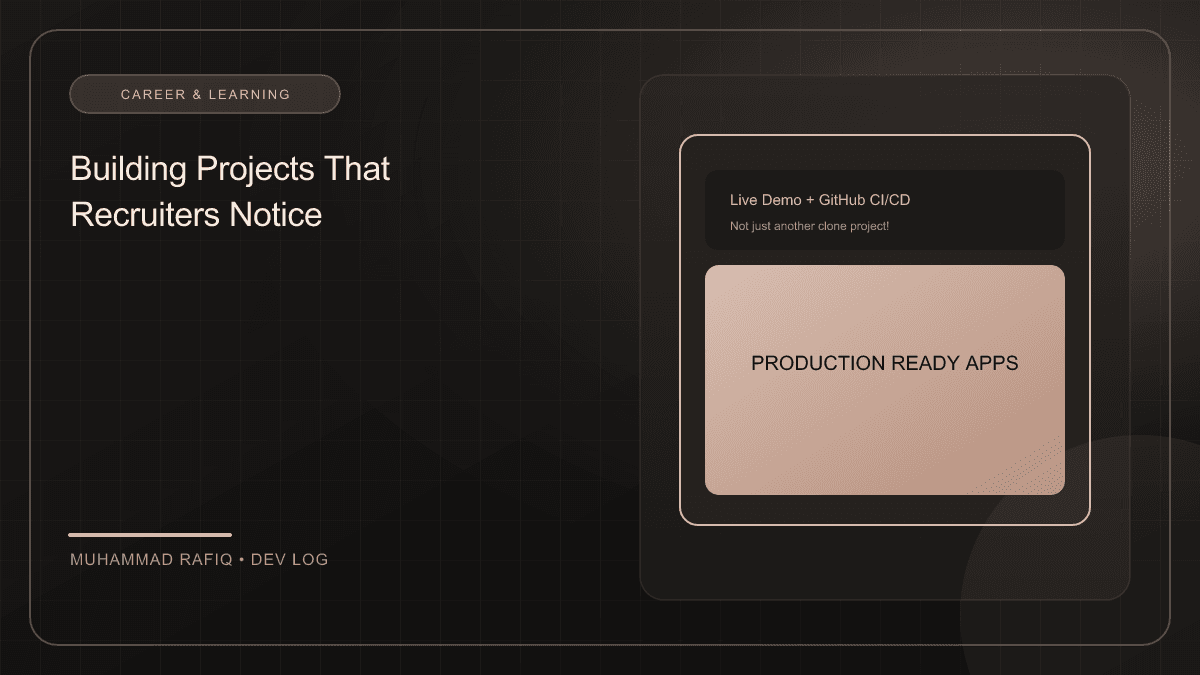
Most developer portfolios look identical: generic shopping carts, simple calculators, and unfinished tasks. Recruiters and engineering managers spend less than 30 seconds reviewing a portfolio. To stand out, you must showcase production-ready projects that demonstrate real-world engineering skills.
Background
Recruiters check three main details: Is the project live and testable? Does the README explain the architecture clearly? Does the codebase have testing, monitoring, and deploy configurations? Projects that include telemetry and automated tests stand out from basic tutorials.
Implementation
I established a checklist to verify all my portfolio projects before publication:
- Live Deployment: Hosting the application on Cloud Run or Vercel, pre-populating mock data so recruiters can test features instantly.
- Production README: Writing detailed documentation that explains the architecture, design tradeoffs, and local installation steps.
- Observability: Adding simple analytics or dashboard alerts (like error logging via Sentry or metrics dashboards).
- Tests and CI/CD: Configuring GitHub Actions to run tests automatically on every pull request.
Challenges
Creating production-ready showcases reveals common hurdles:
- Hosting Costs: Running databases and containers constantly on cloud platforms can exceed developer budgets.
- Complex Setups: Recruiters struggling to sign up or navigate features due to missing instructions or required credentials.
Solutions
I optimized deployment configurations: I utilized serverless databases (like Supabase or Neon Postgres) that scale to zero to minimize costs. I also added a "Sign in with test credentials" button on the login screen to help recruiters test features instantly.
Results
Adding test accounts and clean documentation doubled recruiter engagement on my live sites, and several engineering managers noted the focus on testing and monitoring in feedback.
Conclusion
Quality matters more than quantity. One well-designed, documented, and fully tested SaaS project is more valuable to recruiters than ten simple tutorials.
Frequently Asked Questions
What is the primary topic of Building Projects That Recruiters Notice?
This publication focuses on Career & Learning, specifically detailing Make your portfolio stand out. Learn how to design project showcases, write professional readmes, add monitoring, and host working demos with production-grade setups.
What technologies are discussed in this article?
The implementation leverages Career, Portfolio, JobSearch, Marketing, illustrating best practices for configuration, containerization, and layout routing.
What are the typical deployment challenges encountered in this space?
Developers frequently face difficulties around state management, configuration separation, environment variables scaling, and runtime performance constraints.
How does the suggested architecture resolve these issues?
The proposed architecture separates data schemas, implements modular service layers, isolates build contexts using multi-stage scripts, and integrates error fallbacks.
Where can I learn more about these concepts?
Refer to the references section at the bottom of the article for official links to framework documentations, design patterns libraries, and code templates.