Preparing for AI Engineering Interviews
✦ Quick Answer
Preparing for AI Engineering Interviews is an engineering deep-dive on Career & Learning. Excel in your AI Engineering interviews. Master agentic design patterns, vector databases, prompt engineering, and machine learning concepts. This guide details the core principles, architecture setups, practical implementations, and technical solutions for optimizing this workload in production environments.
TL;DR Summary
What You'll Build
A technical project demonstrating modern implementation practices for Preparing for AI Engineering Interviews.
Technologies Used
Key Learning Outcomes
- Understand fundamental design constraints and architectural principles of Career & Learning.
- Implement step-by-step hands-on configurations and structured source code patterns.
- Identify common implementation mistakes, deployment challenges, and production resolutions.
Introduction
AI Engineering is one of the fastest-growing fields in software development. AI Engineer interviews differ from traditional software roles, requiring candidates to demonstrate knowledge of LLM integration patterns, vector search, prompt tuning, and system design alongside coding skills.
Background
Hiring teams look for two main capabilities: Software Engineering depth (writing clean, scalable code) and AI Integration maturity (understanding token constraints, retrieval-augmented models, context caching, and model evaluation). Candidates must show they can build practical AI applications rather than just calling basic endpoints.
Implementation
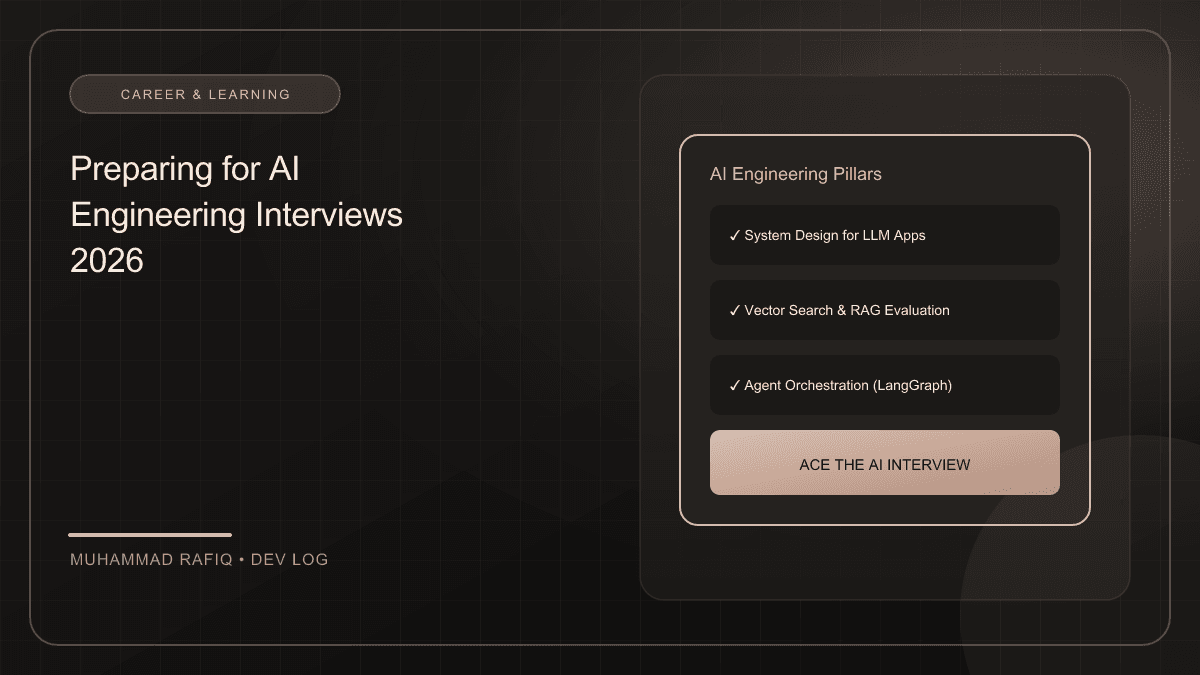
I structured my interview preparation around three core technical pillars:
- AI System Design: Designing RAG pipelines, planning context caching, and coordinating agent workflows.
- Python Coding & SDKs: Mastering prompt templates, function calling parameters, and streaming responses.
- LLM evaluation: Measuring model correctness, response precision, and hallucination rates using frameworks like Ragas.
Challenges
Preparing for these interviews presented two key challenges:
- Fast-moving ecosystem: New models and frameworks are released regularly, making preparation feel outdated.
- Ambiguous System Design: Lack of standard resources for designing AI architectures.
Solutions
I solved this by focusing on fundamentals: I studied core model properties (attention layers, tokenization, context limits) rather than chasing every new library. I practiced designing systems like search engines and coding assistants to improve my architecture skills.
Results
Focusing on foundational concepts helped me handle ambiguous design questions in technical interviews. The structured practice improved my coding confidence and helped me secure AI roles.
Conclusion
AI Engineering interviews require combining coding skills with system design. By mastering RAG patterns, learning context optimization, and understanding model evaluation, you can demonstrate the expertise needed for top roles.
Frequently Asked Questions
What is the primary topic of Preparing for AI Engineering Interviews?
This publication focuses on Career & Learning, specifically detailing Excel in your AI Engineering interviews. Master agentic design patterns, vector databases, prompt engineering, and machine learning concepts with production-grade setups.
What technologies are discussed in this article?
The implementation leverages Career, AI-Engineer, Interviews, StudyGuide, illustrating best practices for configuration, containerization, and layout routing.
What are the typical deployment challenges encountered in this space?
Developers frequently face difficulties around state management, configuration separation, environment variables scaling, and runtime performance constraints.
How does the suggested architecture resolve these issues?
The proposed architecture separates data schemas, implements modular service layers, isolates build contexts using multi-stage scripts, and integrates error fallbacks.
Where can I learn more about these concepts?
Refer to the references section at the bottom of the article for official links to framework documentations, design patterns libraries, and code templates.