How I Became a Full Stack Developer
✦ Quick Answer
How I Became a Full Stack Developer is an engineering deep-dive on Career & Learning. Follow my path to software engineering. Discover the self-study roadmaps, projects, and books that helped me build full-stack applications. This guide details the core principles, architecture setups, practical implementations, and technical solutions for optimizing this workload in production environments.
TL;DR Summary
What You'll Build
A technical project demonstrating modern implementation practices for How I Became a Full Stack Developer.
Technologies Used
Key Learning Outcomes
- Understand fundamental design constraints and architectural principles of Career & Learning.
- Implement step-by-step hands-on configurations and structured source code patterns.
- Identify common implementation mistakes, deployment challenges, and production resolutions.
Introduction
Becoming a software developer is a journey of continuous learning. With new frameworks and tools emerging regularly, the challenge is building a structured path that covers core computer science fundamentals alongside modern full-stack skills.
Background
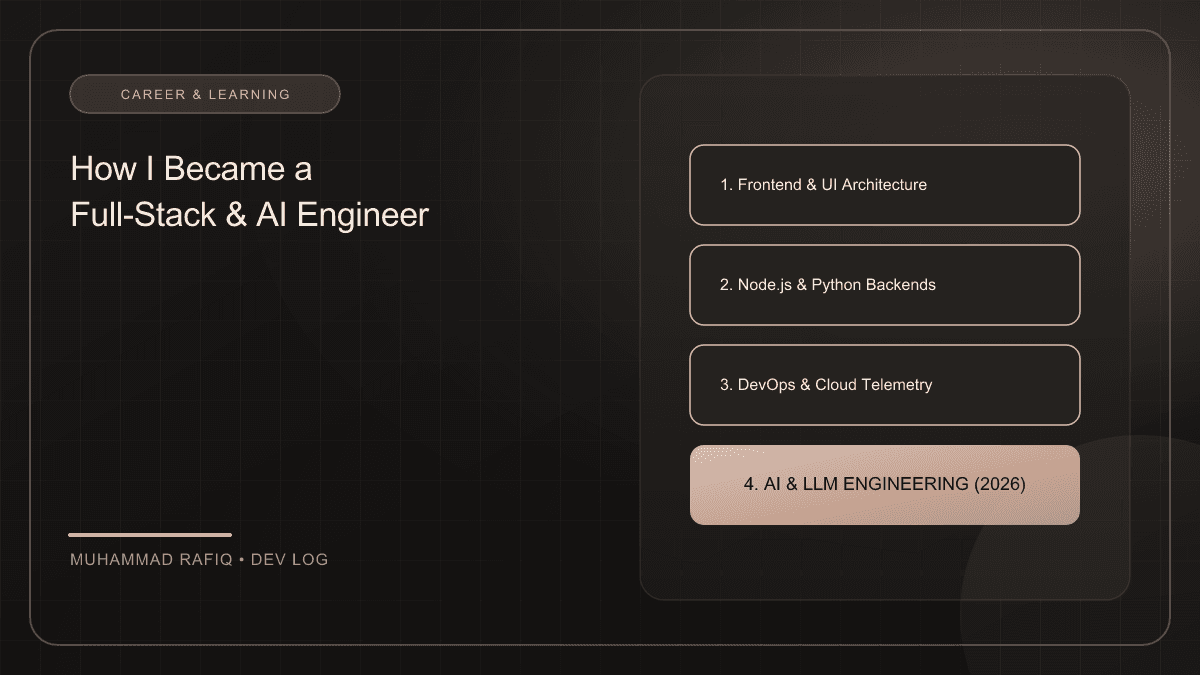
I started by identifying three core competencies: Frontend architecture (HTML, CSS, React), Backend systems (databases, APIs, security), and Systems operations (Docker, CI/CD, hosting). Mastering these required combining self-study with building production-ready projects.
Implementation
My learning roadmap was structured into three consecutive phases:
- Phase 1: Relational Foundations: Learning HTML, CSS, JavaScript, and building responsive websites.
- Phase 2: Full-Stack Integration: Building REST APIs using Express, securing databases (Postgres/MongoDB), and writing React client apps.
- Phase 3: Operations & Scalability: Running services inside Docker containers, building CI/CD pipelines, and deploying to cloud platforms.
Challenges
The journey presented two primary learning challenges:
- Framework Overload: Attempting to learn too many tools simultaneously without understanding core concepts.
- Asymmetric Knowledge: Having weak database knowledge compared to frontend component building.
Solutions
I solved this by establishing a project-based learning model: I limited myself to one primary framework (React) and focused on building complete CRUD applications. I dedicated extra time to SQL queries and database design rules before moving to other technologies.
Results
Sticking to React and Node.js helped me build and deploy several full-stack projects. The structured approach improved my development speed and helped me secure internships and freelance roles.
Conclusion
Becoming a full-stack developer requires persistence. By focusing on core computer science concepts, building complete projects, and automating code delivery, you build a strong foundation for a software engineering career.
Frequently Asked Questions
What is the primary topic of How I Became a Full Stack Developer?
This publication focuses on Career & Learning, specifically detailing Follow my path to software engineering. Discover the self-study roadmaps, projects, and books that helped me build full-stack applications with production-grade setups.
What technologies are discussed in this article?
The implementation leverages Career, FullStack, Roadmap, Self-Study, illustrating best practices for configuration, containerization, and layout routing.
What are the typical deployment challenges encountered in this space?
Developers frequently face difficulties around state management, configuration separation, environment variables scaling, and runtime performance constraints.
How does the suggested architecture resolve these issues?
The proposed architecture separates data schemas, implements modular service layers, isolates build contexts using multi-stage scripts, and integrates error fallbacks.
Where can I learn more about these concepts?
Refer to the references section at the bottom of the article for official links to framework documentations, design patterns libraries, and code templates.