Why AI Replacing Developers is Like Excel Replacing Accountants
✦ Quick Answer
Why AI Replacing Developers is Like Excel Replacing Accountants is an engineering deep-dive on Career & Learning. Is AI going to take over programming? Discover why the rise of AI code generation is like the introduction of spreadsheet software to accountants. This guide details the core principles, architecture setups, practical implementations, and technical solutions for optimizing this workload in production environments.
TL;DR Summary
What You'll Build
A technical project demonstrating modern implementation practices for Why AI Replacing Developers is Like Excel Replacing Accountants.
Technologies Used
Key Learning Outcomes
- Understand fundamental design constraints and architectural principles of Career & Learning.
- Implement step-by-step hands-on configurations and structured source code patterns.
- Identify common implementation mistakes, deployment challenges, and production resolutions.
Introduction
Ever since modern Large Language Models (LLMs) began generating functional code blocks, the tech industry has been filled with predictions of the 'death of programming.' Many commentators assert that software developers will soon be obsolete, replaced entirely by autonomous AI agents. However, looking back at the history of technology reveals a recurring pattern: tool evolutions shift the boundary of human effort, they do not eliminate it. Saying AI will replace software developers is like saying Microsoft Excel replaced accountants in the 1980s.
Background
When computerized spreadsheets like VisiCalc and Microsoft Excel were introduced, they automated arithmetic instantly. Previously, accountants spent hours drawing grids by hand on physical ledger sheets and performing manual mathematics with mechanical calculators. If accounting was merely about adding up numbers, the profession would have vanished. Instead, the number of accountants grew, and their role shifted from tedious calculation to strategic financial analysis, budgeting, and advisory. The spreadsheet didn't replace them; it liberated them and expanded the global demand for financial services by making complex modeling accessible.
The Abstraction Ladder
Programming has always been a continuous climb up the ladder of abstraction. In the early days of computing, developers toggled physical switches or wrote raw binary instructions. Assembly language abstracted away binary into readable mnemonics. High-level compiled languages like C and Fortran allowed developers to write mathematical statements, delegating memory management to compiler routines. Modern languages and frameworks (such as React, Node.js, and cloud APIs) removed the need to manage hardware buffers or route TCP packets manually. Each shift was met with apprehension that engineering jobs would disappear, yet each lower cost of development unlocked massive demand for new software systems.
Challenges
AI code assistants are exceptionally fast at writing localized code blocks, but building high-quality software presents challenges that AI cannot solve alone:
- Ambiguous Requirements: Business stakeholders rarely know exactly what they need in technical terms; translating their human language into clear specifications requires empathy and deep domain knowledge.
- Systems Architecture: Maintaining global modularity, scalability, and security configurations across thousands of files is highly complex and error-prone for AI models.
- Verification and Debugging: When a distributed system fails under load, diagnosing the root cause requires tracing subtle race conditions, checking network latency, and verifying state across microservices.
Solutions
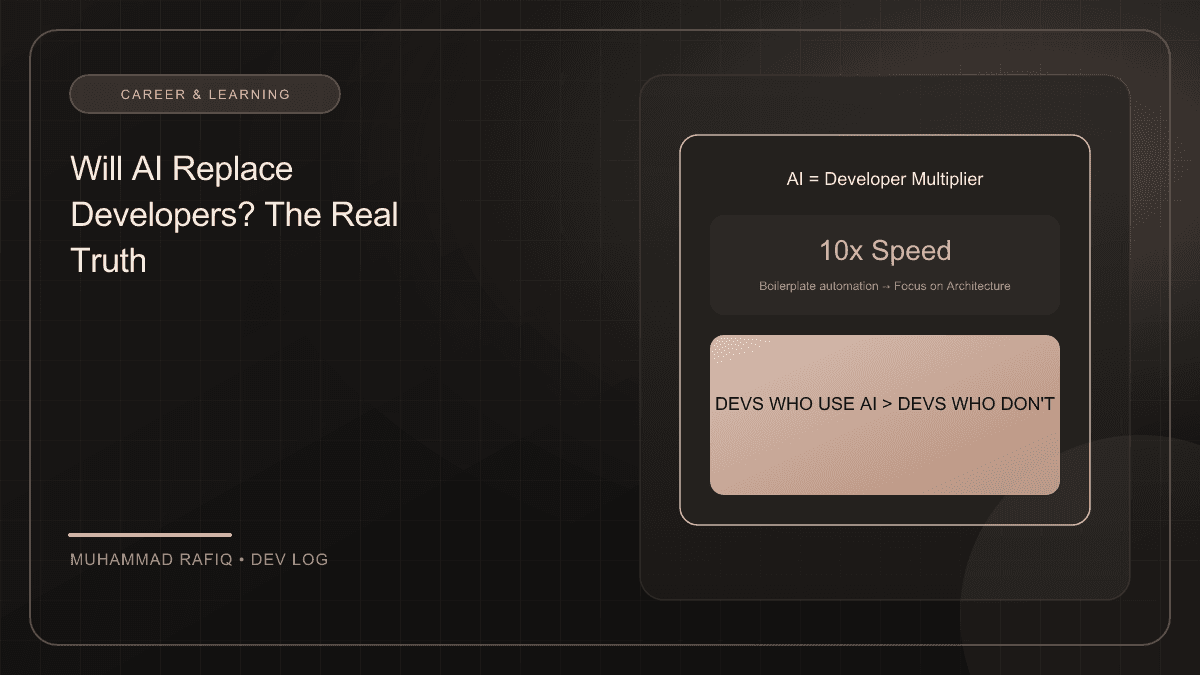
The solution is to view AI not as a replacement developer, but as a hyper-competent compiler that speaks natural language. Developers must use AI tools to automate boilerplate and write raw syntax, while shifting their focus to security controls, architectural integrity, and verifying business logic assumptions. A developer wraps the raw output of AI in robust error handling, schema validations, and unit tests to ensure stability.
Results
Developers who learn to pair program with AI see significant productivity gains. They spend less time memorizing API parameters or typing syntax, and more time designing scalable databases, optimizing core workflows, and understanding user experiences. This transition mirrors the shift from bookkeeper to financial analyst, raising the quality and velocity of software delivery globally.
Conclusion
AI will not replace developers; but developers who use AI will replace those who do not. Programmers are translators of human need into digital systems, and as long as businesses require customized digital workflows, software engineering will remain a vital human-driven discipline.
Frequently Asked Questions
What is the primary topic of Why AI Replacing Developers is Like Excel Replacing Accountants?
This publication focuses on Career & Learning, specifically detailing Is AI going to take over programming? Discover why the rise of AI code generation is like the introduction of spreadsheet software to accountants with production-grade setups.
What technologies are discussed in this article?
The implementation leverages AI, Career, Software Engineering, Productivity, illustrating best practices for configuration, containerization, and layout routing.
What are the typical deployment challenges encountered in this space?
Developers frequently face difficulties around state management, configuration separation, environment variables scaling, and runtime performance constraints.
How does the suggested architecture resolve these issues?
The proposed architecture separates data schemas, implements modular service layers, isolates build contexts using multi-stage scripts, and integrates error fallbacks.
Where can I learn more about these concepts?
Refer to the references section at the bottom of the article for official links to framework documentations, design patterns libraries, and code templates.