Supabase for Full Stack Development
✦ Quick Answer
Supabase for Full Stack Development is an engineering deep-dive on Full Stack Development. Accelerate development using Supabase. Dive into database triggers, real-time sync, and securing object storage policies. This guide details the core principles, architecture setups, practical implementations, and technical solutions for optimizing this workload in production environments.
TL;DR Summary
What You'll Build
A technical project demonstrating modern implementation practices for Supabase for Full Stack Development.
Technologies Used
Key Learning Outcomes
- Understand fundamental design constraints and architectural principles of Full Stack Development.
- Implement step-by-step hands-on configurations and structured source code patterns.
- Identify common implementation mistakes, deployment challenges, and production resolutions.
Introduction
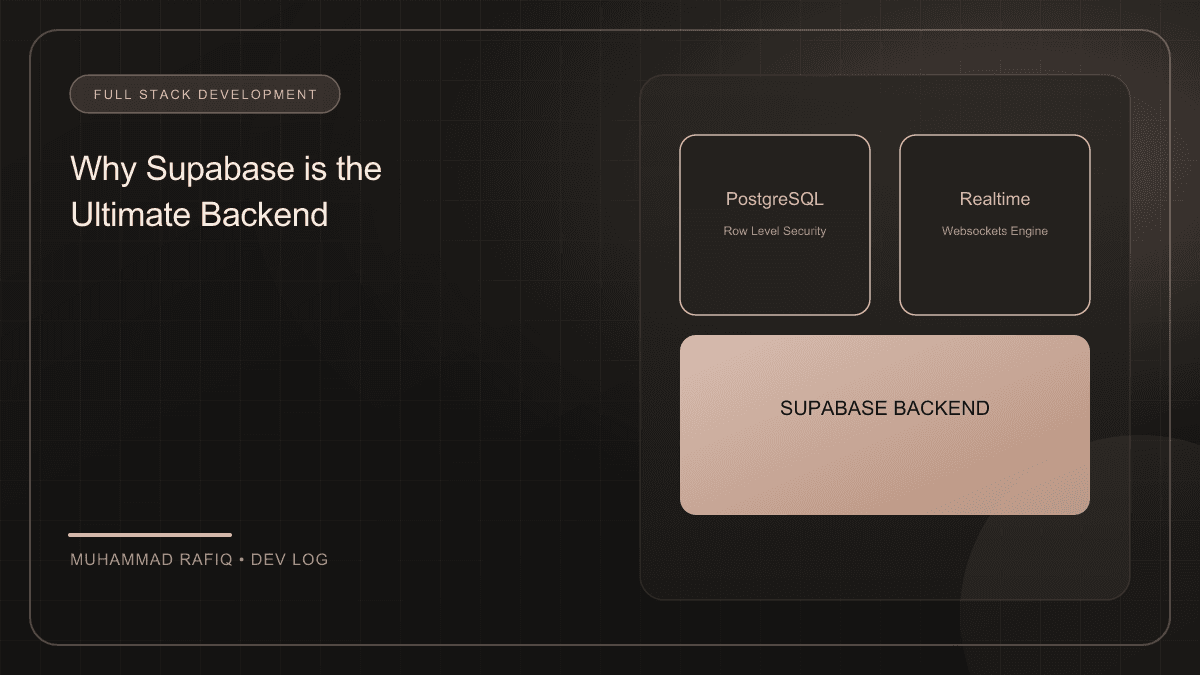
Supabase has emerged as a premier open-source Firebase alternative, providing a full suite of backend tools (Auth, Database, Storage, Edge Functions) built on top of a production-grade PostgreSQL database. By leveraging Supabase, developers can ship features rapidly without managing complex backend architectures.
Background
Traditional serverless backends abstract the database entirely (e.g., Firestore). Supabase, however, exposes the raw PostgreSQL API directly. This lets developers run complex SQL queries, set up database triggers, write stored procedures, and configure robust Row-Level Security (RLS) directly on relational data.
Implementation
We built a real-time message board using Supabase, utilizing Postgres triggers to capture table updates and broadcast them to connected clients.
Challenges
Relying fully on client-side Supabase SDK calls presented unique challenges:
- Complex business logic: Placing complicated validation rules in Postgres triggers became difficult to debug compared to traditional application servers.
- SDK footprint: Managing raw client requests securely without introducing security vulnerabilities in RLS definitions.
Solutions
We solved this by establishing **Supabase Edge Functions** (TypeScript/Deno) to handle payment integrations (Stripe) and complex AI requests, reserving database triggers strictly for simple table operations and sync updates. We also conducted rigorous RLS test dry-runs before deployment.
Results
Offloading heavy operations to Edge Functions kept database query times under 12ms. RLS security checks blocked all unauthenticated writes, while PostgreSQL triggers automated user onboarding flawlessly.
Conclusion
Supabase is a power-tool for rapid prototyping and scalable production apps. By combining RLS, database triggers, and Deno Edge Functions, teams can build complete, secure, real-time products with minimal operational overhead.
Frequently Asked Questions
What is the primary topic of Supabase for Full Stack Development?
This publication focuses on Full Stack Development, specifically detailing Accelerate development using Supabase. Dive into database triggers, real-time sync, and securing object storage policies with production-grade setups.
What technologies are discussed in this article?
The implementation leverages Supabase, React, PostgreSQL, Serverless, illustrating best practices for configuration, containerization, and layout routing.
What are the typical deployment challenges encountered in this space?
Developers frequently face difficulties around state management, configuration separation, environment variables scaling, and runtime performance constraints.
How does the suggested architecture resolve these issues?
The proposed architecture separates data schemas, implements modular service layers, isolates build contexts using multi-stage scripts, and integrates error fallbacks.
Where can I learn more about these concepts?
Refer to the references section at the bottom of the article for official links to framework documentations, design patterns libraries, and code templates.