Authentication in Modern Applications
✦ Quick Answer
Authentication in Modern Applications is an engineering deep-dive on Full Stack Development. Demystify authentication. Compare JSON Web Tokens (JWT) vs Sessions, study OAuth2 flows, and apply industry-standard security safeguards. This guide details the core principles, architecture setups, practical implementations, and technical solutions for optimizing this workload in production environments.
TL;DR Summary
What You'll Build
A technical project demonstrating modern implementation practices for Authentication in Modern Applications.
Technologies Used
Key Learning Outcomes
- Understand fundamental design constraints and architectural principles of Full Stack Development.
- Implement step-by-step hands-on configurations and structured source code patterns.
- Identify common implementation mistakes, deployment challenges, and production resolutions.
Introduction
Authentication is the entry gate of your application. A weak authentication system compromises user data and destroys user trust. Developers must design secure, reliable token systems that protect against hijacking, XSS (Cross-Site Scripting), and CSRF (Cross-Site Request Forgery) attacks.
Background
Historically, web applications stored session IDs in cookies and kept session state in server memory. With the rise of single-page apps and serverless environments, stateless JWTs (JSON Web Tokens) became popular because they don't require database lookups. However, JWT storage on the client presents significant security challenges.
Implementation
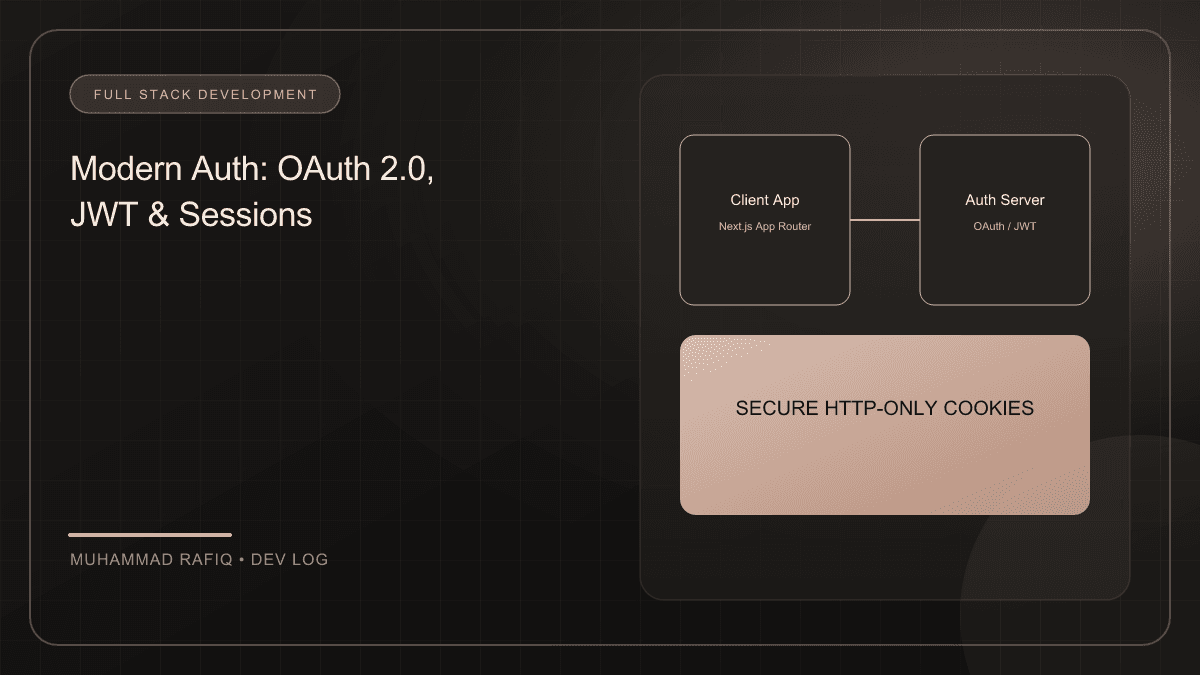
We designed an authentication workflow combining stateful security with stateless scalability. Access tokens are kept in short-lived memory, while refresh tokens are stored in secure, HttpOnly, SameSite=Strict cookies.
Challenges
During deployment, several authentication security vulnerabilities were identified:
- XSS vulnerabilities: Storing JWT tokens in browser localStorage made them readable by malicious script injections.
- CSRF risk: Even with HttpOnly cookies, refresh token routes are vulnerable to CSRF requests unless properly configured.
- Stale sessions: Revoking a compromised user session before the JWT naturally expires is challenging in a fully stateless model.
Solutions
We solved these challenges by implementing three standard defenses:
- Memory Token Management: Storing the access token inside React state rather than localStorage.
- Refresh Token Rotation: Each time a refresh token is used to generate a new access token, the database invalidates it and issues a new refresh token. If a token is reused, the entire session tree is immediately revoked.
- Redis-backed Deny List: Maintain a lightweight Redis blacklist of active JWT IDs (jti) that are checked on incoming secure requests.
Results
Our vulnerability scans resolved all high-risk vulnerabilities, and token rotation prevented session replay hijacks. Redis validation added less than 1.8ms to total endpoint latency, preserving the benefits of fast stateless checks.
Conclusion
Never store sensitive access tokens in localStorage. By utilizing in-memory storage for access tokens and enforcing rotated, secure HttpOnly cookies for refresh tokens, you build a robust defense-in-depth security model.
Frequently Asked Questions
What is the primary topic of Authentication in Modern Applications?
This publication focuses on Full Stack Development, specifically detailing Demystify authentication. Compare JSON Web Tokens (JWT) vs Sessions, study OAuth2 flows, and apply industry-standard security safeguards with production-grade setups.
What technologies are discussed in this article?
The implementation leverages Auth, Security, JWT, OAuth, illustrating best practices for configuration, containerization, and layout routing.
What are the typical deployment challenges encountered in this space?
Developers frequently face difficulties around state management, configuration separation, environment variables scaling, and runtime performance constraints.
How does the suggested architecture resolve these issues?
The proposed architecture separates data schemas, implements modular service layers, isolates build contexts using multi-stage scripts, and integrates error fallbacks.
Where can I learn more about these concepts?
Refer to the references section at the bottom of the article for official links to framework documentations, design patterns libraries, and code templates.