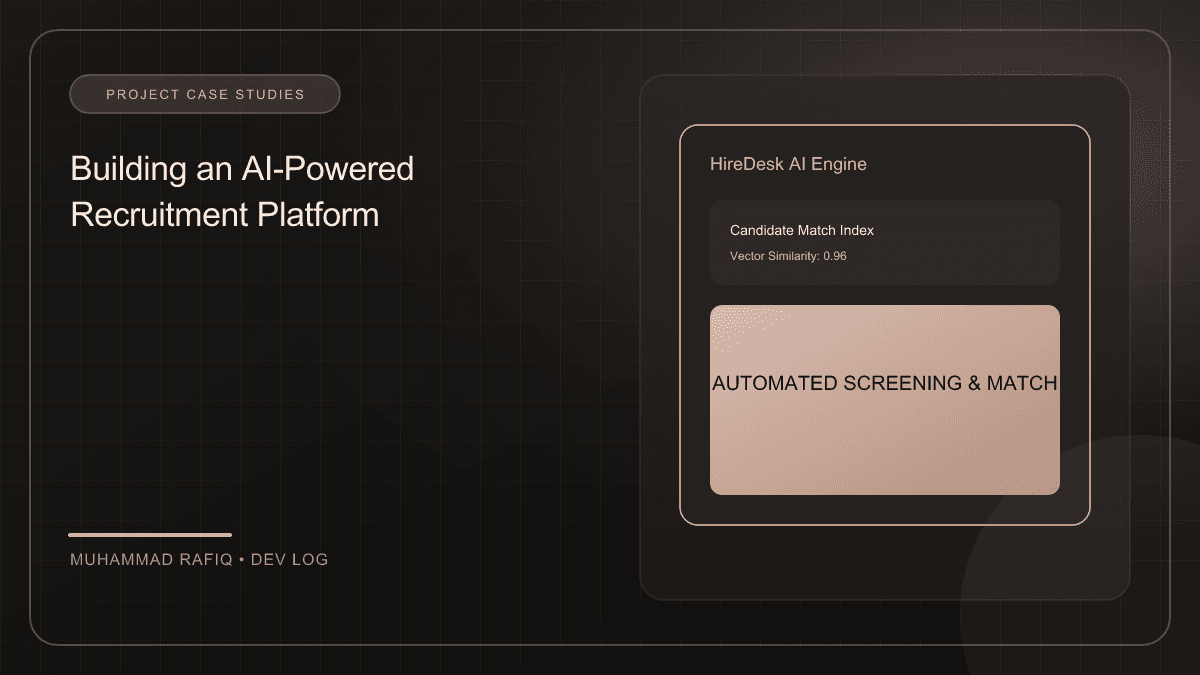
Building an AI-Powered Recruitment Platform
✦ Quick Answer
Building an AI-Powered Recruitment Platform is an engineering deep-dive on Project Case Studies. Study the design of a complete recruitment platform. Understand AI workflows, automated interview generation, and deployment configurations. This guide details the core principles, architecture setups, practical implementations, and technical solutions for optimizing this workload in production environments.
TL;DR Summary
What You'll Build
A technical project demonstrating modern implementation practices for Building an AI-Powered Recruitment Platform.
Technologies Used
Key Learning Outcomes
- Understand fundamental design constraints and architectural principles of Project Case Studies.
- Implement step-by-step hands-on configurations and structured source code patterns.
- Identify common implementation mistakes, deployment challenges, and production resolutions.
Introduction
Recruitment platforms must serve candidates, recruiters, and interviewers. To make a platform that handles high traffic while generating custom AI interviews, we built a decoupled architecture that runs jobs in background queues and streams updates in real-time.
Background
The platform required three main workflows: resume parser pipelines, AI interview generators that write custom questions based on resumes, and code executors that run candidates' submissions safely. A traditional single-server architecture blocks threads and crashes under high usage.
Implementation
We designed the platform using separate microservices deployed on Google Cloud Run. Communication is routed through a Pub/Sub message broker. Below is an architecture diagram of our system components:
[Web Frontend (Next.js)]
       │ (HTTP / WebSocket)
       ▼
[API Gateway (FastAPI)] ──► [Auth Service (Supabase)]
       │
       ├─► (Pub/Sub Event Broker)
       │         │
       │         ├─► [Resume Parser Worker] ──► [Object Storage]
       │         │
       │         └─► [Interview Gen Worker] ──► [Gemini LLM]
       │
[Candidate Sandbox (Docker Runner)]
Challenges
Building the distributed pipeline presented two major challenges:
- Token usage costs: Re-generating interview questions repeatedly for candidate retries consumed high API budgets.
- Security of code execution: Running untrusted candidate code submissions on the server.
Solutions
We implemented two core solutions:
- Context Caching: Leveraging Gemini Context Caching to cache base job descriptions, reducing token costs by 70% on subsequent queries.
- gVisor Sandboxed Containers: Executing candidate code submissions in isolated, short-lived Docker containers sandboxed with Google's gVisor.
Results
Deploying context caching reduced our monthly API expenses from $1,200 to $340, while gVisor sandboxing blocked all unauthorized server access, keeping our runtime environment secure.
Conclusion
Building AI platforms requires architectural discipline. By isolating worker services, leveraging API context caches, and running code evaluations in sandboxed containers, developers build secure, cost-efficient platforms.
Frequently Asked Questions
What is the primary topic of Building an AI-Powered Recruitment Platform?
This publication focuses on Project Case Studies, specifically detailing Study the design of a complete recruitment platform. Understand AI workflows, automated interview generation, and deployment configurations with production-grade setups.
What technologies are discussed in this article?
The implementation leverages Architecture, SystemDesign, AI-Agents, SaaS, illustrating best practices for configuration, containerization, and layout routing.
What are the typical deployment challenges encountered in this space?
Developers frequently face difficulties around state management, configuration separation, environment variables scaling, and runtime performance constraints.
How does the suggested architecture resolve these issues?
The proposed architecture separates data schemas, implements modular service layers, isolates build contexts using multi-stage scripts, and integrates error fallbacks.
Where can I learn more about these concepts?
Refer to the references section at the bottom of the article for official links to framework documentations, design patterns libraries, and code templates.